
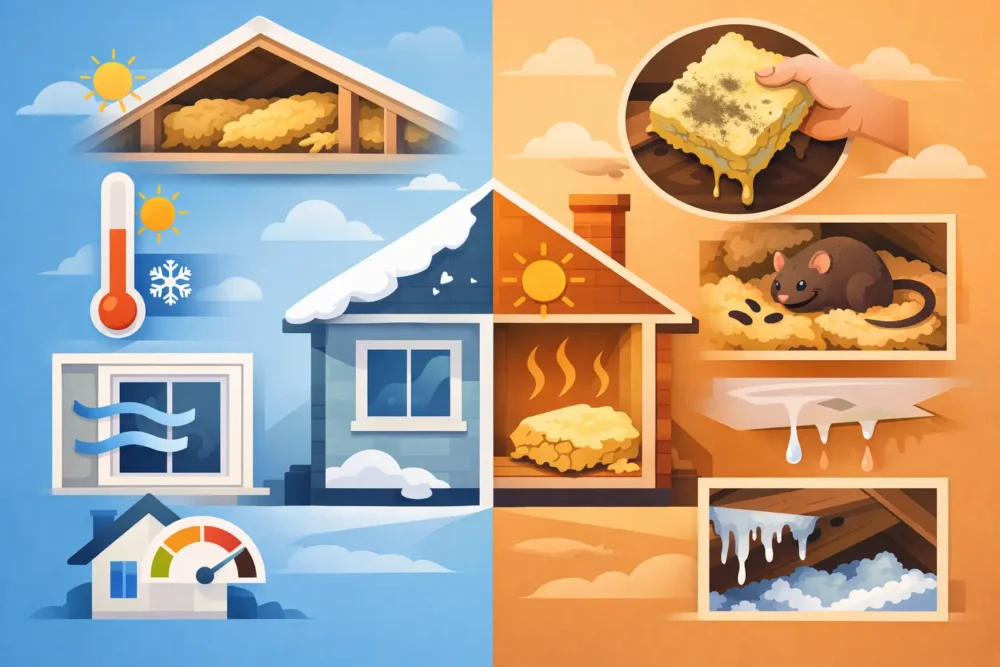
If one room in your house feels fine and the next feels like a different season, insulation may be part of the problem. Many homeowners start looking for the top signs insulation needs replacement after utility bills rise or comfort drops, but the warning signs often show up earlier in the attic, walls, or crawl space.
Insulation is easy to forget because it sits behind drywall or above the ceiling, doing its job quietly when everything is working well. But insulation does not last forever in every situation. Age, moisture, air leaks, rodent activity, and poor installation can all reduce performance long before homeowners realize what is happening.
This is one of those home issues where the symptoms can feel vague at first. The house just seems harder to heat or cool. Certain rooms never quite settle at the right temperature. The HVAC system runs longer. Over time, those small frustrations start costing real money.
Top signs insulation needs replacement in a home
The clearest sign is often a steady increase in heating and cooling costs without a clear change in how you use the house. Energy bills do rise with utility rates and weather swings, so one expensive month does not prove much. But if your HVAC system is working harder year after year and your home still feels less comfortable, insulation should be inspected.
Another common sign is uneven temperature from room to room. Upstairs spaces that are always too hot in summer, bonus rooms that stay chilly in winter, and floors that feel cold underfoot can all point to missing, compressed, or underperforming insulation. In many homes, the problem is not just low insulation levels. It is a combination of weak insulation and uncontrolled air leakage.
Drafts are another clue people often notice before they think about insulation. If you feel air movement around ceiling fixtures, attic hatches, exterior walls, or floors above a crawl space, the house may be losing conditioned air. Technically, drafts are often an air sealing issue first, but insulation and air sealing work together. Replacing insulation without addressing leaks can leave part of the problem behind.
Visible damage matters too. In attics, insulation that looks flattened, shifted, dirty, or patchy may no longer be doing the job it was meant to do. Insulation works by trapping air. Once it becomes compressed or disturbed, its effective performance drops. In wall and ceiling cavities, homeowners may not see the material directly, but recurring comfort issues can still point to breakdown or gaps.
Moisture, contamination, and pest damage
Moisture is one of the biggest reasons insulation needs replacement rather than just an upgrade. If insulation has been wet from a roof leak, plumbing issue, condensation, or crawl space humidity, it may lose much of its insulating value. More importantly, damp insulation can contribute to musty odors, mold concerns, and poor indoor air quality.
In crawl spaces, moisture problems can quietly damage insulation for a long time. Fiberglass batts may sag, fall, or hold moisture against subfloor areas. That can affect comfort above and create conditions that are less healthy for the home overall. In those cases, replacing insulation alone is not enough. The source of moisture has to be corrected, often with better vapor control, air sealing, and ventilation planning depending on the space.
Rodent activity is another major warning sign. If pests have nested in attic or crawl space insulation, the issue goes beyond lost R-value. Contaminated insulation can hold droppings, urine, odors, and debris. Even if only part of the area looks affected, contamination often spreads more than homeowners expect. Removal, sanitizing, rodent proofing, and replacement may all be part of the right fix.
Smoke, dust, and lingering odors can also settle into insulation over time, especially in older homes or after a major event. Not every odor means full replacement is necessary, but if the insulation is heavily soiled or contaminated, keeping it in place may continue the problem.
When old insulation stops performing well
Age alone does not automatically mean insulation has failed. Some materials can continue performing for many years if they stay dry, undisturbed, and properly installed. But older homes often have insulation levels that no longer match current expectations for comfort and energy efficiency.
That is especially true in attics. Many older homes simply do not have enough insulation depth by modern standards. Even if the existing material is still somewhat intact, it may be too thin to control heat gain and heat loss effectively. This is where a professional inspection matters. The answer may be replacement, an added layer, or a more complete attic improvement plan.
Older insulation can also hide other problems. If the attic floor has never been properly air sealed, adding more material on top without addressing leaks can limit results. If soffit vents are blocked or ventilation is poor, the attic may trap heat and moisture that reduce system performance. A homeowner may think the insulation is the only issue when the bigger picture involves the whole home envelope.
Signs in the attic and crawl space that should not be ignored
The attic and crawl space tell the real story in many homes. If you see insulation that is matted down, missing in sections, pushed aside around mechanical work, or darkened from dust trails, that usually points to air movement and lost effectiveness. Dust streaking is not just cosmetic. It can show where air is passing through or around insulation.
In crawl spaces, insulation hanging from the floor joists is a strong sign something has gone wrong. It may have been poorly attached, exposed to moisture, or damaged by pests. If the floors above feel cold in winter or humid in summer, the crawl space should be evaluated as part of the problem.
Homeowners in the St. Louis area also deal with big seasonal swings, which tend to expose insulation weaknesses quickly. A house that struggles during both humid summers and cold winters often has performance issues that a simple thermostat adjustment will not solve.
Replacement is not always the same as adding more
One of the biggest misconceptions is that more insulation automatically fixes everything. Sometimes that is true. If the existing insulation is dry, clean, and properly installed, adding more may improve comfort and efficiency.
But replacement becomes the better choice when insulation is contaminated, wet, compressed, mold-affected, pest-damaged, or installed in a way that leaves major gaps. In those cases, covering old material with new insulation can trap problems underneath. It may also make future repairs harder and reduce the value of the upgrade.
This is where a full-service approach matters. A proper recommendation should look at insulation levels, air leakage, ventilation, moisture conditions, and contamination concerns together. That is how homeowners get lasting results instead of a partial fix.
What a professional inspection can reveal
A good inspection does more than confirm that insulation is present. It looks at condition, depth, coverage, and what may be reducing performance. Thermal imaging can help identify hot and cold areas that are not obvious to the eye. An attic inspection may reveal bypasses around recessed lighting, top plates, duct penetrations, and attic access points. A crawl space inspection may uncover vapor issues, damaged insulation, or signs of pests.
That matters because insulation problems are often layered. A homeowner may call about high bills and discover the house also has attic air leaks, contaminated insulation, and weak ventilation. Solving the whole issue at once is usually more cost-effective than chasing symptoms one by one.
For homeowners who want clearer answers, Better Home Insulation focuses on inspection-led recommendations so the work matches the actual condition of the home. That means the solution can be as simple as targeted upgrades or as involved as removal, sealing, sanitation, and replacement, depending on what the home needs.
When to stop waiting
If your home is less comfortable than it used to be, your energy bills keep climbing, or you have reason to suspect moisture or rodent damage, it is worth having the insulation checked sooner rather than later. Waiting can turn a manageable insulation issue into a bigger repair involving odors, mold growth, or ongoing HVAC strain.
The helpful thing about insulation problems is that they are usually diagnosable. You do not have to guess whether the attic is under-insulated or whether the crawl space is contributing to cold floors. A thorough inspection can show what is happening and what will actually improve comfort, cleanliness, and efficiency.
A house should feel steady, not unpredictable. When it does not, the insulation is often telling you something.