
A roof can look fine from the street while its underside is dealing with excess heat, trapped humidity, or slow condensation. That is why attic ventilation for roof lifespan is about much more than adding a few vents. A properly designed attic system helps protect the roof deck, shingles, insulation, and indoor comfort at the same time.
For homeowners, the goal is not simply to make the attic colder. The goal is to manage heat and moisture in a way that fits the home’s design, insulation level, roof layout, and local climate. When ventilation is paired with air sealing and proper insulation, it can help prevent conditions that shorten a roof’s service life and raise heating and cooling costs.
Why attic ventilation affects roof lifespan
Your attic sits between conditioned living space and the outdoors. In summer, the roof absorbs solar heat and can make the attic extremely hot. In winter, warm, moisture-laden household air can leak upward through gaps around light fixtures, plumbing penetrations, duct chases, attic hatches, and wall openings.
If that moisture reaches a cold roof deck, it can condense into water droplets or frost. Over time, repeated moisture exposure may stain roof sheathing, encourage mold growth, corrode metal fasteners, compress or contaminate insulation, and contribute to wood deterioration. Those problems often remain hidden until a homeowner notices a ceiling stain, musty odor, or damaged shingles.
Heat matters, too. High attic temperatures can place added stress on roofing materials, especially when ventilation is restricted. Ventilation will not stop a roof from getting hot under direct sun, and it cannot overcome poor roofing installation or worn-out shingles. It can, however, help the attic shed excess heat and reduce the extreme conditions that work against roofing materials over many seasons.
A longer-lasting roof depends on several factors: shingle quality, flashing details, drainage, weather exposure, maintenance, and installation workmanship. Attic ventilation is one important part of that larger system.
How a balanced ventilation system works
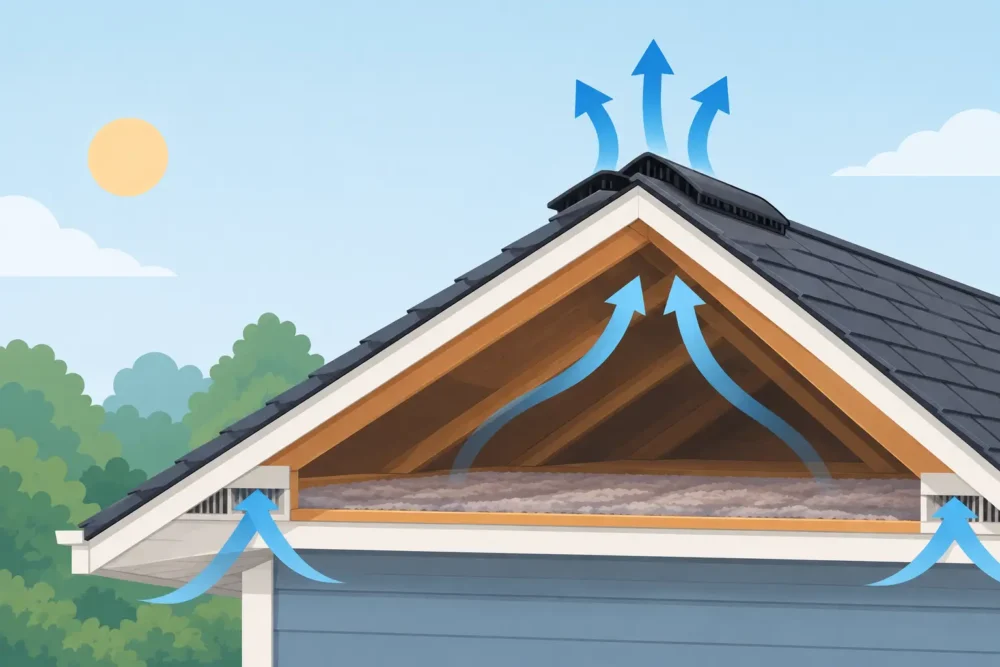
Most vented attics work best with a continuous path for air to enter low and leave high. Cooler outside air enters through intake vents near the lower roof edge, commonly soffit vents. As attic air warms, it rises and exits through high-level exhaust vents, such as ridge vents or properly placed roof vents.
This low-to-high airflow is more effective than placing a few vents wherever there is room. An attic may have plenty of exhaust ventilation but still perform poorly if insulation blocks the soffit openings or if there is not enough intake area. Without adequate intake, exhaust vents can draw air from the house through ceiling leaks instead. That can pull conditioned air into the attic, increase utility costs, and deliver more indoor moisture where it does not belong.
Intake and exhaust need to be matched
Ventilation design is not a matter of adding the most vents possible. Too little intake limits airflow. Too much exhaust without sufficient intake can create the wrong pressure path. Mixing several exhaust types – for example, ridge vents with gable vents or roof turbines – can also cause air to short-circuit between nearby openings rather than traveling from the soffits across the attic.
Ventilation professionals evaluate net free vent area, the actual open area available for airflow after accounting for screens and louvers. Building requirements often use ventilation ratios such as 1:150 or, in appropriate conditions, 1:300. The right calculation depends on the attic size, vapor control details, roof configuration, and local code requirements. A home inspection should determine the correct approach rather than relying on a one-size-fits-all vent count.
Baffles protect the airflow path
In an insulated attic, baffles or ventilation chutes are often installed at the eaves. They keep loose-fill or batt insulation from blocking soffit vents while preserving a channel between the roof deck and insulation.
This detail is easy to overlook, but it has a major effect on performance. Adding more insulation without protecting the intake path can leave the home with better R-value but reduced attic ventilation. The best solution handles both needs correctly.
Ventilation cannot fix attic air leaks
This is one of the most common misconceptions homeowners encounter. Ventilation removes some heat and moisture from an attic, but it cannot reliably solve a large amount of air leakage from the living space below.
A bathroom fan that vents into the attic, an unsealed attic hatch, or gaps around recessed lights can release warm, humid air directly into the attic. During Missouri winters, that moisture may collect on the roof sheathing and freeze. When temperatures rise, it melts and can look like a roof leak even when the roofing itself is intact.
Air sealing should usually come before adding insulation or making ventilation changes. Common sealing locations include top plates, plumbing and electrical penetrations, chimney chases, duct penetrations, and the attic access opening. Bathroom and kitchen exhaust fans should terminate outdoors, not into the attic, soffit, or an enclosed roof cavity.
Once major air leaks are sealed, insulation helps keep indoor heat where it belongs. That reduces the amount of warm air available to drive moisture into the attic and improves comfort in rooms below.
Signs your attic may need attention
Some ventilation and moisture issues can be seen from inside the attic, while others show up in daily living areas. A professional inspection is worthwhile if you notice recurring ice buildup at roof edges, damp or frosted roof decking, rusty nails protruding through sheathing, dark staining on wood, mold-like growth, or a persistent musty smell.
Other clues include upstairs rooms that are difficult to cool, unusually high summer energy bills, insulation that looks matted or damp, or bathroom fans that do not visibly vent outdoors. Shingle curling, premature granule loss, and roof deck sagging also deserve prompt attention, although they can have causes beyond ventilation.
Rodent activity can complicate the picture. Damaged insulation, chewed ventilation screens, and contaminated attic materials affect energy performance and sanitation. In those cases, the solution may include removal and disposal of affected insulation, rodent proofing, cleaning, air sealing, and replacement insulation – not ventilation work alone.
Choosing the right attic ventilation approach
The correct system depends on how the attic is built. A simple gable roof may allow for straightforward soffit-and-ridge ventilation. A complex roof with multiple ridges, dormers, valleys, or limited soffit area may need a more customized plan. Cathedral ceilings and enclosed rafter cavities require careful detailing because airflow pathways are narrower and insulation choices are more limited.
Powered attic fans are sometimes appropriate, but they are not automatically the best answer. If the attic floor has air leaks, a powered fan can pull conditioned air out of the home and increase cooling costs. Solar fans raise similar considerations. Before adding mechanical ventilation, it is smarter to inspect intake ventilation, exhaust placement, attic air sealing, insulation coverage, and duct leakage.
Likewise, a radiant barrier can reduce radiant heat transfer in certain attic conditions, but it does not replace insulation or ventilation. Each measure has a role, and the most effective plan is the one that addresses the actual source of the problem.
A practical plan for homeowners
Start with an attic inspection that looks at the complete home envelope, not just the visible vents. The inspection should identify blocked soffits, missing or poorly located exhaust vents, exposed ceiling gaps, disconnected ducts, moisture staining, insulation depth, and signs of pests or contamination.
From there, prioritize repairs in the right order. Correct active roof leaks first. Seal major attic air leaks and ensure exhaust fans vent outside. Restore unobstructed intake and properly designed exhaust ventilation. Then install or improve insulation to the recommended level for the home and climate.
For homeowners in St. Louis and surrounding Missouri communities, seasonal temperature swings make this whole-house approach especially valuable. A hot, humid summer and a cold winter can expose weaknesses that are easy to miss during a quick visual check.
Better Home Insulation can assess ventilation, insulation, air leakage, moisture concerns, and attic conditions together, then explain the practical repairs that will make the greatest difference. A clear inspection and estimate give you a better basis for protecting your roof than guessing based on a single symptom.
Your roof is a major investment, but the space beneath it deserves equal attention. Addressing attic airflow, air leaks, insulation, and moisture before damage becomes visible can help keep the roof system dry, the home more comfortable, and future repairs more manageable.