
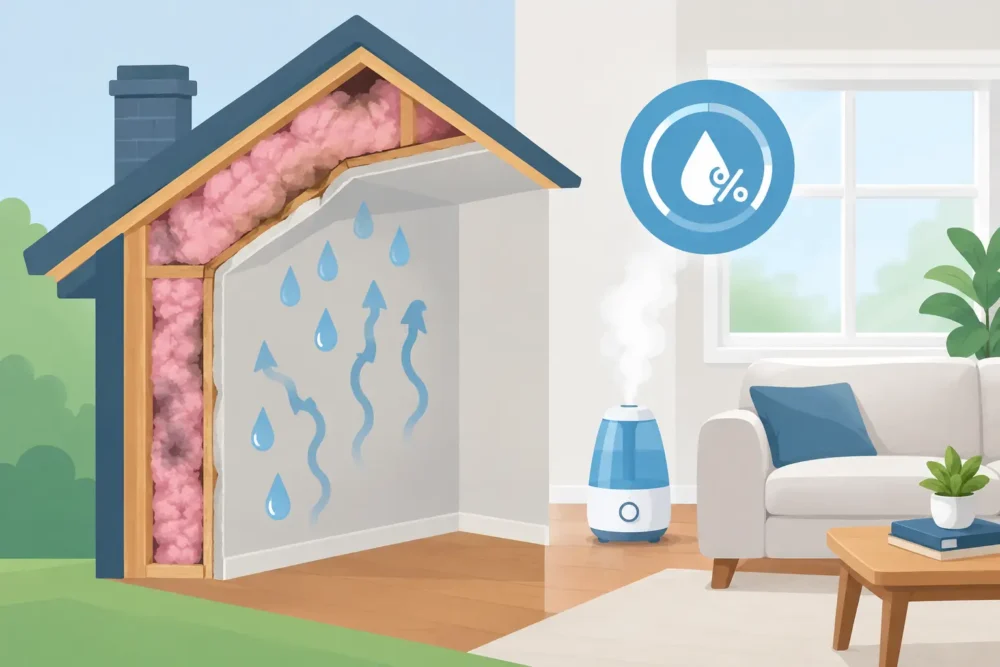
A bedroom that feels clammy in summer, windows that sweat on cold mornings, or a musty crawl space are not always signs that you simply need a bigger dehumidifier. Can bad insulation cause indoor humidity problems? Yes – although insulation does not create moisture on its own, damaged, missing, or poorly installed insulation can make moisture much harder to control.
The reason is simple: your insulation, air sealing, ventilation, and moisture barriers work together as a system. When one part fails, humid outdoor air can enter, indoor surfaces can become cold enough for condensation, and heating and cooling equipment may struggle to keep up. The result can be uncomfortable rooms, higher utility bills, mold-friendly conditions, and avoidable damage inside the home.
How bad insulation affects indoor humidity
Insulation slows heat transfer. In winter, it helps keep interior surfaces warmer. In summer, it helps keep attic heat and humid outdoor conditions from affecting the rooms below. When insulation is thin, compressed, wet, contaminated, or missing, those surfaces are less protected from outdoor temperature swings.
That matters because warm air holds more moisture than cool air. When humid indoor air touches a cold wall, ceiling, window frame, duct, or other surface, the air can release water as condensation. You may see visible droplets on windows, but condensation can also occur inside wall cavities, around attic penetrations, or beneath floors where it remains hidden.
Poor insulation can also make your HVAC system run inefficiently. Air conditioners remove moisture while they cool, but a home with major heat gain and air leaks may never maintain steady conditions. Some systems run too long trying to overcome the load; others cycle on and off without running long enough to dehumidify effectively. Insulation improvements do not replace proper HVAC sizing, but they can reduce the strain on the system.
Air leaks often cause the bigger humidity problem
Insulation and air sealing are related, but they are not the same service. Fiberglass, cellulose, and similar insulation materials slow heat movement. They do not reliably stop moving air. If warm, humid outdoor air can travel through gaps around wiring, plumbing pipes, recessed lights, attic hatches, rim joists, and duct openings, it can carry a surprising amount of moisture into the home.
In the St. Louis area, summer humidity makes these leaks especially noticeable. Attic bypasses can allow hot, humid attic air to affect ceiling cavities and upper-level rooms. In winter, warm household air can rise into the attic through the same openings. There, it may condense on cold roof decking or framing, creating conditions that can lead to staining, wood moisture, and mold growth.
Adding new insulation over unsealed gaps may improve comfort somewhat, but it can leave the primary moisture pathway in place. A proper inspection should identify air leaks before insulation is installed or replaced whenever possible.
Why wet insulation performs poorly
Insulation that has absorbed moisture is less effective because water displaces air pockets that normally slow heat transfer. Wet or matted insulation can also hide the source of a roof leak, plumbing leak, condensation issue, or pest entry point.
If attic or crawl space insulation is visibly damp, has a persistent odor, shows discoloration, or has been contaminated by rodents, covering it with more material is rarely the right answer. The source of moisture should be corrected first. In some cases, removal and disposal of damaged insulation creates the clean, accessible surface needed for proper air sealing, repairs, and replacement.
Crawl spaces can raise humidity throughout the home
A damp crawl space is one of the most common hidden contributors to indoor humidity issues. Moisture can enter through exposed soil, foundation vents, plumbing leaks, groundwater, and humid outdoor air. From there, it can move upward through gaps in the floor system and affect the rooms above.
Homes with fiberglass insulation hanging below the subfloor sometimes have a false sense of protection. If the crawl space stays damp, that insulation may sag, absorb moisture, or become a home for mold and pests. The floor above can feel cold in winter, while the house may develop a musty odor during humid weather.
The right solution depends on the structure and moisture source. It may include crawl space insulation removal, a properly installed vapor barrier, air sealing at the rim joist and penetrations, drainage corrections, and ventilation improvements. More airflow is not automatically better. In a humid climate, bringing additional outdoor air into a crawl space can increase moisture rather than solve it.
Signs insulation may be contributing to moisture issues
Humidity problems have several possible causes, so it is wise to look for patterns instead of assuming one issue is responsible. Insulation and air leakage deserve a closer look when you notice four or more of the following conditions:
- Upper rooms that are hotter and more humid than the rest of the house
- Condensation on windows, supply vents, pipes, or cold interior surfaces
- Musty odors from the attic, crawl space, closets, or lower level
- Uneven temperatures, unusually high energy bills, or frequent HVAC cycling
- Damp, compressed, rodent-damaged, or stained attic and crawl space insulation
These clues do not automatically mean the home needs additional insulation. For example, window condensation can be related to indoor humidity levels, weak windows, poor air circulation near the glass, or a combination of those factors. Likewise, a humid home may have a disconnected bath fan, an unvented dryer, a plumbing leak, or an oversized air conditioner. A complete assessment prevents money from being spent on the wrong fix.
The best fix starts with finding the moisture path
Effective humidity control is not about adding the most insulation possible. It is about correcting the specific ways heat, air, and moisture are moving through your home.
A professional inspection may include checking attic depth and condition, looking for bypasses around ceiling penetrations, examining roof decking for moisture evidence, evaluating crawl space conditions, and identifying damaged or contaminated materials. Thermal imaging can help locate temperature irregularities that point to missing insulation or air leakage. It is especially useful when the problem is behind a finished ceiling or wall.
From there, the work can be prioritized. Roof, plumbing, or foundation water intrusion should come first. Next, close major air leaks and address damaged insulation. Then install the appropriate insulation level and moisture-control materials for the location. Ventilation should be evaluated as part of the whole system, including attic ventilation, bath exhaust, kitchen exhaust, and crawl space conditions.
A vapor barrier is useful in the right location, but it is not a universal cure. Its placement and material should match the assembly and local conditions. An improperly selected barrier can trap moisture instead of managing it. This is one reason customized recommendations are more reliable than a one-size-fits-all insulation package.
What homeowners can do now
Start by using a hygrometer to check indoor relative humidity in several areas of the home. Many households are comfortable around 30% to 50% relative humidity, though the ideal level can vary by season and outdoor temperature. If readings stay high, record when and where the problem is worst.
Also make sure bathroom fans exhaust outdoors and run long enough after showers, and confirm that dryer vents terminate outside. Check for obvious plumbing drips, wet insulation, roof stains, and disconnected ductwork. Avoid blocking soffit vents with attic insulation, but do not mistake ventilation for air sealing. Those are separate functions, and both need to be handled correctly.
For persistent concerns, a professional home-envelope inspection can bring clarity. Better Home Insulation helps homeowners identify whether insulation, air leaks, crawl space moisture, ventilation, or contaminated materials are affecting comfort and air quality. The goal is a practical repair plan that improves the home rather than masking symptoms.
If your home feels damp, uneven, or harder to cool than it should, treat those symptoms as useful information. Finding the moisture path early can protect your comfort, your energy budget, and the building materials that make up your home.