
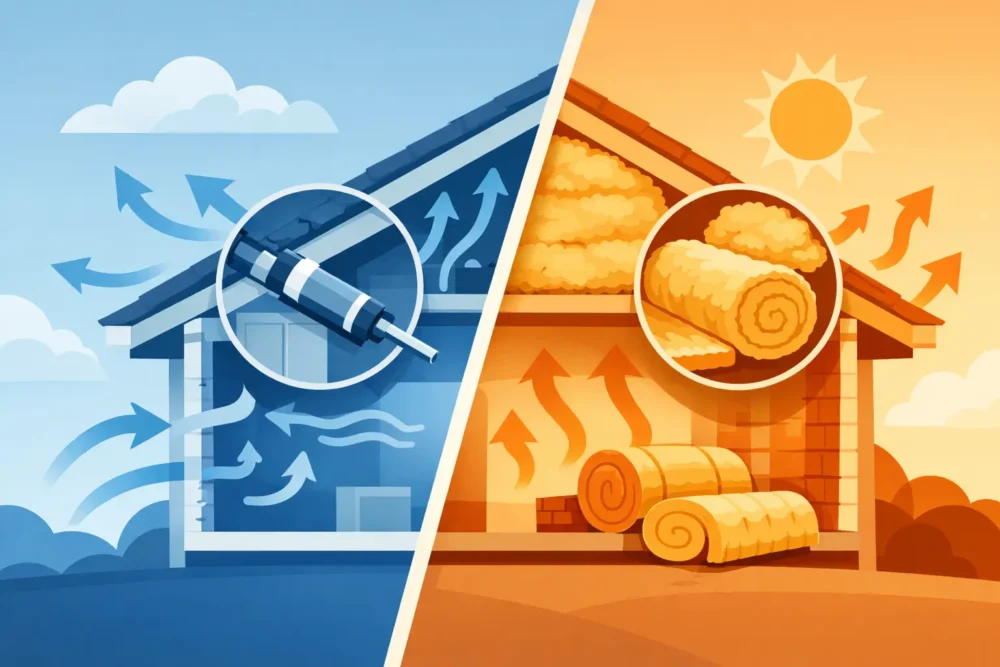
If your upstairs is always hotter in summer, your furnace seems to run nonstop in winter, or certain rooms never feel comfortable, the real question usually is not whether you need more insulation. It is often air sealing vs insulation – and knowing how those two work together is what leads to lasting results.
Homeowners often hear these terms used like they mean the same thing. They do not. Insulation slows heat transfer. Air sealing stops unwanted air movement. One helps hold conditioned air where it belongs, and the other helps reduce how quickly heat moves through the home envelope. When either one is missing, comfort drops and energy costs rise.
Air sealing vs insulation: the basic difference
Think of insulation as your home’s thermal blanket. It helps keep heat inside during winter and outside during summer. That is why attic insulation, wall insulation, and crawl space insulation matter so much. The right insulation level can make a noticeable difference in indoor comfort and monthly utility bills.
Air sealing does a different job. It targets the gaps, cracks, and openings that let outside air leak in and indoor air leak out. These openings are often hidden around attic penetrations, recessed lights, top plates, duct chases, plumbing stacks, wiring holes, access hatches, rim joists, and crawl space transitions. Even small leaks add up.
A home with plenty of insulation but poor air sealing can still feel drafty, dusty, humid, and uneven. A home with good air sealing but weak insulation can still struggle to maintain temperature. That is why the better question is usually not which one is better. It is which problem is affecting your home most right now, and whether both need attention.
Why air leaks cause bigger problems than many homeowners realize
Many people assume high energy bills come from not having enough insulation. Sometimes that is true. But uncontrolled air leakage is often a major part of the problem, especially in attics and crawl spaces.
When warm indoor air escapes into the attic during winter, it carries heat and moisture with it. That moisture can contribute to condensation, reduce insulation effectiveness, and create conditions that support mold or material damage. In summer, hot attic air can work its way into the living space through gaps and bypasses, making rooms harder to cool.
Air leaks can also pull in dust, insulation fibers, outdoor pollutants, and pest-related contaminants. In homes with older or damaged insulation, this becomes even more noticeable. If an attic has rodent activity, for example, air leakage can help carry unpleasant odors and unhealthy particles into the house.
That is one reason inspection matters. A home may look like it simply needs more insulation, but thermal imaging and a careful visual assessment often reveal that the bigger issue is air escaping through hidden openings.
When insulation is the bigger issue
There are also plenty of homes where insulation really is the main concern. Older homes may have low insulation levels by current standards. Existing insulation may have settled, been compressed, gotten wet, or been contaminated. In attics, insulation can be uneven or missing in key areas. In crawl spaces, the wrong material may have been installed for the conditions present.
When insulation is inadequate, heat moves through ceilings, walls, and floors more easily. That can lead to cold floors in winter, overheated upstairs rooms in summer, and HVAC systems that work harder than they should. If you have ever noticed one part of the house is comfortable while another feels impossible to regulate, insulation may be part of the reason.
Still, adding insulation without addressing major air leaks can limit the benefit. That is where many homeowners get frustrated. They pay for more insulation and expect a dramatic change, only to find the house still feels drafty or uneven. The insulation is doing its job, but air is still moving around it.
Which should come first?
In most homes, air sealing should happen before adding insulation, especially in the attic. That order matters because once new insulation is installed, many of the leakage points underneath become harder to access properly.
Sealing first allows technicians to close bypasses around penetrations, framing gaps, chases, and attic access points. After that, insulation can be installed to the proper depth and coverage. This creates a stronger thermal and air boundary, which is what improves comfort and efficiency.
That does not mean every project starts the same way. If insulation is soaked, pest-damaged, or badly deteriorated, removal may need to come first. If crawl space moisture is the underlying issue, vapor barrier work and moisture control may need to be addressed before insulation decisions are finalized. Good recommendations come from looking at the whole system, not just one material.
Air sealing vs insulation in the attic
The attic is one of the most common places where homeowners lose money and comfort. Heat rises, and so does air leakage. If the attic floor has unsealed penetrations, your home can act like a chimney, constantly losing conditioned air.
This is why attic upgrades often involve more than blowing in new insulation. Proper attic work may include removing damaged material, sealing leaks, correcting ventilation issues, and then installing insulation to the right level. If one part is skipped, the overall result can fall short.
For homeowners in the St. Louis area, this matters even more because homes deal with both hot, humid summers and cold winters. A poorly sealed and underinsulated attic gets exposed from both directions, making indoor comfort harder to maintain year-round.
Crawl spaces and wall cavities are different
Attics get most of the attention, but crawl spaces are another major source of performance issues. Air leakage, exposed floors, moisture intrusion, and missing vapor barriers can all work together to make the home feel uncomfortable above. Floors may feel cold, indoor humidity may rise, and musty odors can spread.
In crawl spaces, air sealing vs insulation is rarely a simple one-or-the-other conversation. Moisture control is often part of the answer. If insulation is installed in a damp environment without addressing the source of the moisture, the material may sag, fail, or contribute to poor air quality.
Walls can be more complicated still. Unlike an open attic, wall cavities are less accessible, so the strategy depends on the home’s construction, existing insulation condition, and signs of leakage or temperature imbalance. This is where diagnostics help separate guesswork from useful recommendations.
The trade-offs homeowners should understand
There is no single upgrade that fixes every comfort issue. Air sealing can reduce drafts and improve efficiency, but if the insulation level is far below what the home needs, temperature control may still be inconsistent. Insulation can improve thermal resistance, but if attic leaks are left open, the home may still lose conditioned air and pull in outside air.
There is also a budget question. Some homeowners want to tackle the highest-impact improvement first and phase the rest later. That can be a smart approach, but only if the work is prioritized correctly. A focused inspection helps identify where your dollars will make the biggest difference instead of treating symptoms one at a time.
Another trade-off is ventilation. A tighter home is often a better-performing home, but sealing should be done thoughtfully. The goal is not to trap moisture or create stale indoor conditions. It is to stop uncontrolled leakage while keeping the home properly ventilated where needed.
So, what matters most?
If you are weighing air sealing vs insulation, the honest answer is that both matter, but they do not always matter equally in every house. In many cases, air sealing delivers the first major improvement because it addresses hidden leakage that undermines everything else. In other homes, damaged or insufficient insulation is the bigger gap. Most of the time, the best results come from combining both in the right order.
That is why a one-size-fits-all quote rarely tells the full story. The homes that perform best are the ones where the problem was identified first, then matched with the right solution – whether that means attic air sealing, insulation removal and replacement, crawl space upgrades, vapor barrier installation, ventilation corrections, or a combination of services.
A more comfortable home usually does not come from adding material and hoping for the best. It comes from understanding where your home is losing energy, where outside air is getting in, and what will fix those issues for the long term. If your home has stubborn hot and cold spots, rising utility bills, or signs of attic or crawl space trouble, a careful inspection can turn confusion into a clear plan.