
A cold upstairs bedroom, rooms that heat up too quickly in summer, and utility bills that keep climbing often point to the same problem: insulation that is missing, underperforming, or installed in the wrong way. When homeowners compare blown insulation vs batt insulation, the best option is rarely about choosing the material with the lowest initial price. It is about selecting an insulation system that fits the space, controls heat loss, and works alongside proper air sealing and moisture protection.
Both insulation types can improve comfort and energy efficiency. The right choice depends on where the insulation is going, the condition of the existing material, whether the area has obstructions, and what is causing the home’s performance problem in the first place.
Blown Insulation vs Batt Insulation: The Main Difference
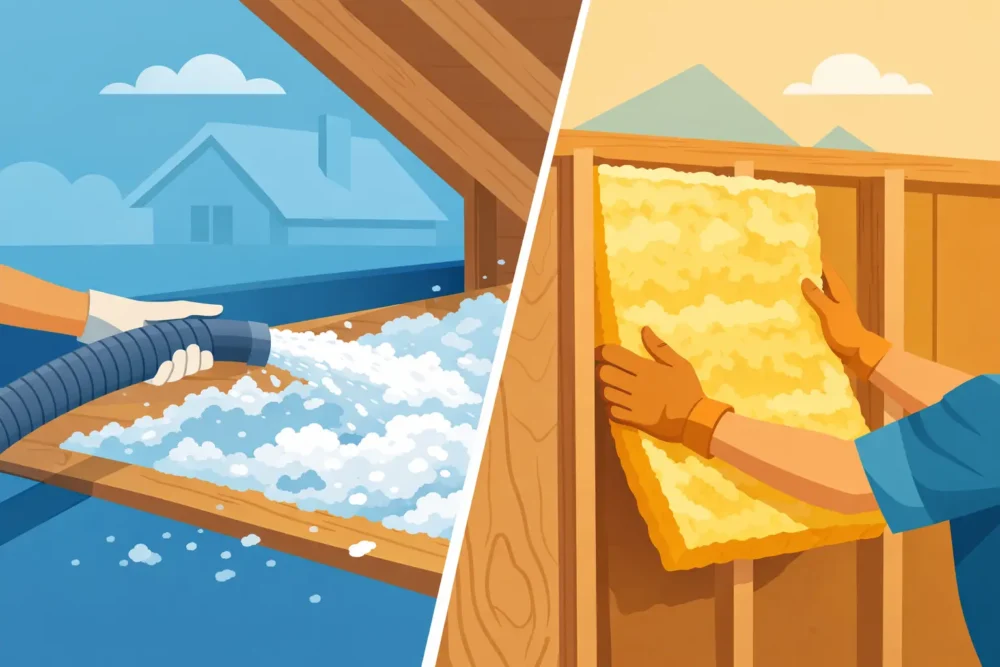
Batt insulation comes in pre-cut rolls or rectangular panels, commonly made from fiberglass or mineral wool. It is designed to fit between standard framing members such as wall studs, ceiling joists, or floor joists. When installed carefully in an open, regularly framed area, batts can deliver dependable thermal performance.
Blown insulation consists of loose fibers or particles that are installed with specialized equipment. Common options include blown fiberglass and cellulose. The installer distributes the material across an attic floor or dense-packs it into enclosed wall cavities, creating a continuous blanket of insulation around pipes, wires, framing irregularities, and other obstacles.
The difference matters because insulation only works as intended when it fully covers the area without gaps, compression, or voids. A small opening around a plumbing stack or an uninsulated section near an attic edge may not look significant, but it can contribute to uncomfortable rooms and unnecessary heating and cooling costs.
When Blown Insulation Is the Better Fit
Blown insulation is often the strongest choice for unfinished attics, particularly when an existing home needs additional insulation over the attic floor. Attics are rarely simple open rectangles. They often contain wiring, ductwork, recessed areas, framing variations, and hard-to-reach edges. Blown material can fill around these details more evenly than pre-cut batts.
It is also useful when existing attic insulation is in place but does not provide enough R-value. Rather than disturbing insulation that is clean, dry, and in acceptable condition, a professional may recommend air sealing first and then adding blown insulation to reach an appropriate depth. R-value measures resistance to heat flow. Higher R-values generally offer better insulating performance, but the target should match the home’s climate, construction, and the space being insulated.
Dense-packed blown insulation can also be an effective option for existing walls. Adding insulation to closed wall cavities requires a different process than insulating a new construction wall. A professional can evaluate whether a wall is empty, partially insulated, affected by moisture, or obstructed by old materials before recommending a method.
Blown insulation does have trade-offs. It requires installation equipment and an experienced crew to achieve even coverage and the intended density. Cellulose can settle somewhat over time if it is not installed to the correct depth. The attic also needs to be assessed for air leaks, roof leaks, pest activity, and ventilation concerns. Adding insulation over wet, contaminated, or rodent-damaged material does not solve the underlying issue.
Where Batt Insulation Performs Well
Batt insulation is a practical fit for accessible areas with consistent spacing between framing members. Open wall cavities during remodeling, crawl space walls, rim joists, and certain floor systems may be good candidates. Mineral wool batts can be especially useful where moisture resistance and fire resistance are priorities, while fiberglass batts are widely used and available in many thicknesses and R-values.
The key is precise installation. Batts should fit snugly without being crammed into a space that is too small. Compressing insulation reduces its effective R-value. Leaving spaces at the edges, cutting around electrical boxes poorly, or placing batts around wires without proper contact creates pathways for heat to move through the assembly.
Batt insulation can also be easier to remove and replace in a localized area. For example, if a section of an accessible crawl space or wall is opened during a repair, batts may make sense because the installer can inspect the cavity and place each piece with care.
However, batt insulation can be less forgiving in irregular spaces. It is difficult to install flawlessly around numerous obstructions, angled framing, or narrow attic edges. In those situations, the apparent savings from a lower-cost material can be offset by gaps that reduce real-world performance.
Air Sealing Comes Before More Insulation
Insulation slows heat transfer, but it does not stop moving air. That distinction is one of the most important parts of improving an attic or crawl space.
Warm indoor air can escape through openings around plumbing penetrations, wiring holes, top plates, chimneys, attic hatches, and recessed fixtures. During a Missouri winter, that escaping air can carry heat and moisture into the attic. In summer, hot attic air can contribute to heat gain and make upper floors harder to cool.
Before installing blown or batt insulation, an inspection should identify and seal appropriate air leaks. This is also the time to look for disconnected ducts, inadequate ventilation, water staining, mold concerns, and evidence of rodents. A clean, dry, air-sealed attic gives new insulation the conditions it needs to perform.
In crawl spaces, insulation decisions should be paired with moisture management. Depending on the crawl space design and condition, that may include a vapor barrier, targeted air sealing, insulation at the walls or floor system, and correction of drainage or humidity issues. The right approach is based on the space itself, not a one-size-fits-all recommendation.
Cost Depends on the Whole Job, Not Just the Material
It is understandable to compare insulation by price per square foot, but material cost is only one part of the project. Blown insulation may involve equipment and professional installation, while batt installation can require more cutting and detailed fitting. Removal and disposal may be needed if existing insulation is heavily compacted, wet, contaminated, or affected by pests.
The better value is the solution that addresses the source of the problem. If an attic has major air leaks and thin insulation, simply laying new batts over the old material may not produce the comfort improvement a homeowner expects. If a crawl space has moisture-damaged insulation, replacing it without addressing humidity can lead to the same issue again.
A qualified inspection helps clarify the scope before work begins. Thermal imaging can help identify temperature differences, while a visual evaluation can reveal insulation depth, settling, staining, pest damage, and accessible air leakage points. That information makes it easier to choose a solution that is likely to last.
How to Choose for Your Home
Choose blown insulation when you need broad, consistent coverage in an attic, need to fill irregular spaces, or want to improve insulation in an existing enclosed wall. It is commonly the preferred method for topping off attic insulation because it can create a uniform layer over the entire attic floor.
Choose batt insulation when the cavity is open and accessible, framing is regular, and the material can be installed without gaps or compression. It can be an excellent option in planned renovations, new framing, accessible crawl space areas, and repairs where direct placement is possible.
In some homes, the answer is both. A property may benefit from blown insulation across the attic floor, batt insulation in an accessible crawl space wall, air sealing around attic penetrations, and a vapor barrier below the home. Each measure supports the others.
For homeowners in the St. Louis area, seasonal humidity, hot summers, and cold winter periods make these details especially worthwhile. Better Home Insulation provides inspection-led recommendations so homeowners can understand whether blown insulation, batts, removal, air sealing, or moisture and pest remediation will make the most meaningful difference.
If your home has uneven temperatures, high energy bills, or an attic that has not been evaluated in years, start with the condition of the space rather than the insulation type alone. A thorough inspection and a clear estimate can turn a frustrating comfort problem into a practical plan for a cleaner, quieter, more efficient home.