
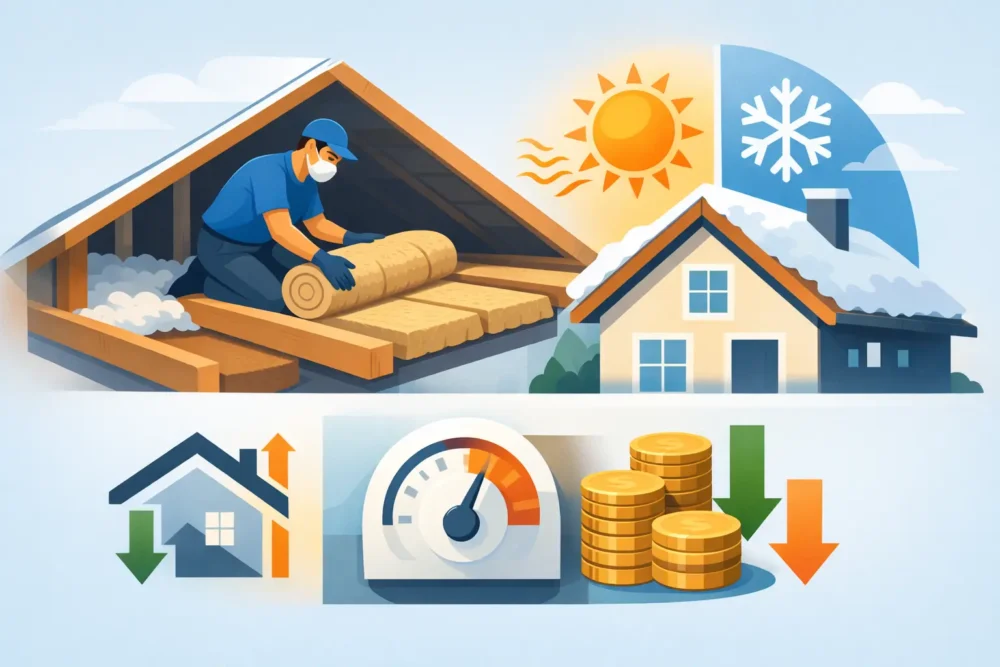
If your upstairs rooms are hard to cool in summer, or your furnace seems to run nonstop in winter, the problem may be sitting right above your ceiling. Attic insulation plays a major role in how comfortable your home feels and how much you spend to heat and cool it. When it is underperforming, missing, contaminated, or installed over untreated air leaks, the result is usually the same – uneven temperatures, higher utility bills, and a home that never feels quite right.
For many homeowners, the attic gets attention only when there is a roof issue or obvious damage. But the attic is one of the most important parts of the home envelope. It affects comfort, energy efficiency, indoor air quality, and even how hard your HVAC system has to work day after day. Good insulation helps, but the best results usually come from looking at the whole attic system rather than treating insulation like a stand-alone product.
Why attic insulation matters so much
Heat naturally moves from warmer areas to cooler ones. In winter, that means heat inside your home wants to escape upward. In summer, attic heat pushes down into the living space below. Attic insulation slows that transfer, which helps your home hold a more stable indoor temperature.
That sounds simple, but real homes are rarely simple. Insulation only performs the way it should when it is the right type, installed to the proper depth, and paired with good attic air sealing. If outside air is leaking in through gaps around top plates, wiring penetrations, recessed lights, bath fan openings, or attic hatches, even decent insulation can fall short.
This is why some homeowners add insulation and still feel disappointed. The insulation was not necessarily the wrong choice. The attic just had other problems working against it.
Signs your attic insulation may need attention
A home does not need to be old to have attic problems. Newer homes can have gaps, compressed insulation, poor coverage, or ventilation issues. Older homes often have additional concerns such as settled material, outdated insulation levels, moisture exposure, pest activity, or contamination.
A few warning signs tend to show up again and again. Your second floor may feel hotter or colder than the rest of the home. Rooms may have cold drafts in winter or stubborn heat in summer. Utility bills may keep climbing even though your HVAC equipment is running normally. You may notice dusty indoor air, musty attic smells, or insulation that looks flattened, stained, or disturbed.
If there has been rodent activity in the attic, that changes the conversation quickly. Once insulation is contaminated by droppings, urine, nesting debris, or strong odors, the issue is no longer just energy efficiency. It becomes a sanitation and indoor air quality concern too.
Attic insulation works best with air sealing
One of the most common mistakes in attic upgrades is skipping air sealing. Insulation slows heat transfer, but it does not stop moving air. If your attic has open gaps and penetrations, conditioned air from inside the home can escape into the attic, while unconditioned air finds its way in.
That air movement can reduce comfort and waste energy year-round. It can also carry moisture into the attic, which is where bigger problems sometimes begin. Over time, excess moisture can contribute to mold growth, wood damage, and reduced insulation performance.
This is why a proper attic inspection matters. Before adding more material, it helps to understand whether the attic has hidden leakage points, ventilation concerns, or damaged areas that should be addressed first. In many homes, air sealing and insulation together deliver better results than insulation alone.
What type of attic insulation is right?
The best choice depends on your home, the current condition of the attic, and what problem you are trying to solve. Blown-in insulation is a common option for attics because it covers large areas well and fills around framing and obstacles more effectively than batt insulation. It is often a strong fit when the goal is improving coverage over an existing attic floor.
Batt insulation can work well in specific situations, especially where framing is regular and installation can be done carefully. The trade-off is that it leaves less room for error. Gaps, compression, or uneven placement can reduce performance.
The target is not just adding material. It is reaching the proper insulation level for the home while preserving ventilation pathways and avoiding installation problems that can limit results. That is one reason professional assessment matters. The right recommendation depends on the attic layout, the age of the home, and whether the existing insulation should stay, be supplemented, or be removed.
When attic insulation should be removed first
Not every attic needs full insulation removal. Sometimes the existing material is dry, clean, and still useful as part of an upgrade. In other cases, removal is the smarter and safer starting point.
Contaminated insulation is the clearest example. If pests have been in the attic, if there is widespread droppings or urine contamination, or if odors have settled into the material, covering it up with new insulation does not solve the problem. The same is true when insulation has been heavily damaged by moisture or has deteriorated to the point that it no longer performs well.
Removal also makes sense when hidden issues need to be accessed. Exposed attic floors allow technicians to identify air leaks, damaged ductwork, compromised areas around penetrations, and signs of moisture trouble that would otherwise stay buried.
For homeowners in the St. Louis area, this is especially relevant after long seasons of humidity, storms, and temperature swings. Those conditions can expose weak points in an attic faster than many people realize.
R-value matters, but it is not the whole story
Homeowners often hear about R-value because it measures an insulation material’s resistance to heat flow. Higher R-value generally means better thermal performance, but it is only part of the picture.
If insulation is compressed, wet, missing in spots, or installed over major air leaks, the labeled R-value will not reflect real-world performance. Think of it this way: the number matters, but so does the installation quality and the condition of the attic around it.
A good contractor should be able to explain recommended insulation levels in plain language and connect those recommendations to actual problems you are experiencing, like hot bonus rooms, rising bills, or drafts near ceiling fixtures. Homeowners do not need a complicated lecture. They need a clear plan that matches the house.
Ventilation and radiant heat also affect attic performance
Attic insulation does a lot, but it cannot solve every attic-related issue by itself. If the attic has poor ventilation, trapped heat and moisture can still build up. If radiant heat from the roof is a major factor, additional measures such as radiant barrier improvements may be worth discussing.
This is where a full-service, inspection-led approach helps. Homes are systems. When insulation, air sealing, ventilation, and remediation are considered together, the results are usually more noticeable and more durable.
That does not mean every home needs every service. Some attics need only added insulation and basic sealing. Others need removal, sanitizing, rodent proofing, or ventilation corrections before new insulation goes in. It depends on what the inspection reveals.
What to expect from a professional attic evaluation
A useful attic inspection should do more than glance at insulation depth. It should look for gaps, signs of contamination, moisture issues, ventilation problems, disturbed insulation, and evidence that energy is escaping through the ceiling plane. Diagnostic tools such as thermal imaging can also help identify hidden performance problems that are easy to miss in a basic visual check.
From there, the recommendation should feel tailored, not generic. A homeowner with clean but insufficient insulation needs a different solution than a homeowner with rodent-damaged material and air leakage around multiple penetrations. Both have attic problems, but the scope and sequence of the work are not the same.
That is where working with a company like Better Home Insulation can make the process easier. When one team can inspect, explain, remove damaged material if needed, seal leaks, install new insulation, and address related attic issues, homeowners get a more complete fix instead of a partial one.
The real payoff of better attic insulation
The goal is not simply to have more insulation in the attic. The real payoff is a home that feels more consistent, costs less to condition, and puts less strain on the equipment you rely on every day.
Many homeowners notice the difference first in comfort. Rooms stop swinging so far between hot and cold. Floors feel less chilly in winter. Upstairs spaces become easier to live in during summer. Over time, lower heating and cooling demand can also help reduce monthly utility costs.
There is also peace of mind in knowing the attic is not hiding bigger problems. When insulation, air sealing, contamination concerns, and ventilation are addressed properly, the home tends to perform better as a whole.
If your home has been sending small signals – rising bills, uneven temperatures, persistent drafts, or signs of attic damage – it is worth taking them seriously. A well-planned attic upgrade can solve more than one problem at once, and the improvement is something you feel every day.