
Older homes tell on themselves in the attic.
If upstairs rooms are too hot in summer, too cold in winter, or your energy bills keep climbing without a clear reason, the attic is often where the problem starts. When homeowners ask about the best attic insulation options for older houses, the real answer usually involves more than picking a material off a shelf. In an older home, insulation has to work with the structure, ventilation, air leakage, and sometimes years of dust, rodent activity, or damaged material already in place.
What makes older attics different
Older houses were built in a different era, and many were never designed around modern energy-efficiency standards. Some have little insulation at all. Others have insulation that has settled, gotten wet, been compressed by storage, or been contaminated over time. It is also common to find major air leaks around recessed lights, plumbing penetrations, chimney chases, attic hatches, and top plates.
That matters because insulation slows heat transfer, but it does not stop air movement on its own. If warm or hot air is freely moving through the attic floor, even good insulation can underperform. In many older houses, comfort problems are caused by a combination of missing insulation and uncontrolled air leakage.
This is why a proper attic recommendation starts with inspection, not guesswork. The best result often comes from pairing attic air sealing with the right insulation depth and type.
Best attic insulation options for older houses
There is no single best material for every older home. The right choice depends on the attic layout, existing conditions, access, budget, and whether the current insulation should stay or be removed.
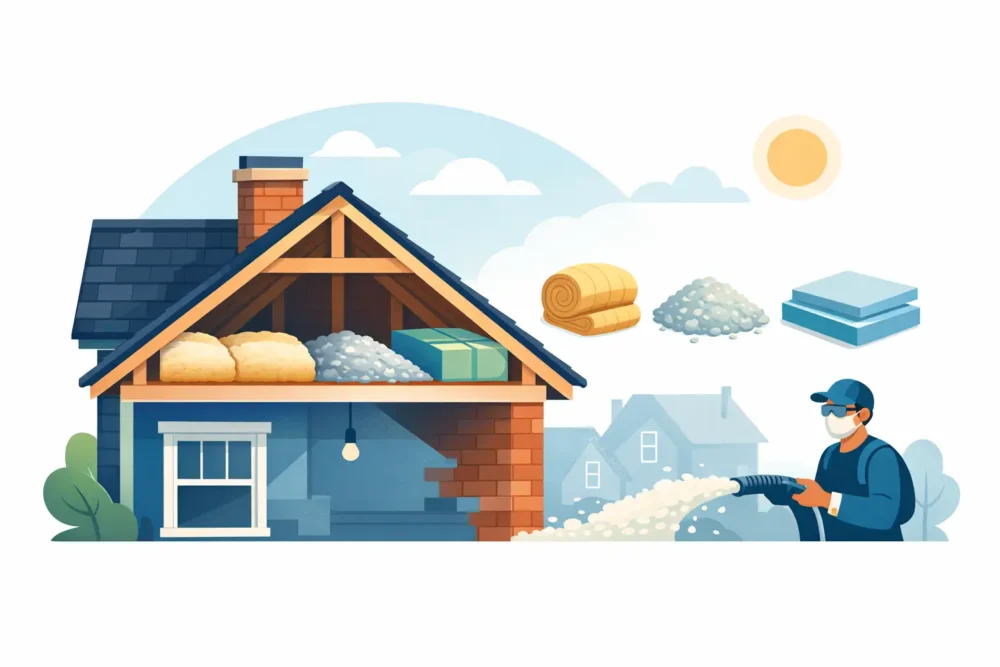
Blown-in fiberglass
Blown-in fiberglass is one of the most common solutions for older attics, especially when the goal is to add coverage evenly across an open attic floor. It fills around joists and irregular spaces better than batt insulation and can be installed to a consistent depth for improved thermal performance.
For many homeowners, this is a practical middle-ground option. It performs well, installs efficiently, and works especially well when the attic first gets properly air sealed. If an older attic has patchy or insufficient insulation but the existing material is dry and in acceptable condition, blown-in fiberglass can often be added on top to improve the overall R-value.
The trade-off is that fiberglass does not solve air leaks by itself. If bypasses and gaps are left open, you may still deal with drafts and heat gain or loss.
Blown-in cellulose
Cellulose is another strong option for older houses. It is dense, effective at covering irregular surfaces, and often chosen for its ability to reduce airflow better than loose fiberglass when installed correctly. In homes with lots of small gaps and unusual framing conditions, cellulose can perform very well.
It can be an especially good fit for attics in older neighborhoods where framing is less uniform and there are more penetrations through the ceiling plane. Cellulose also tends to settle into cavities and around obstructions nicely, which helps create more complete coverage.
The main caution is moisture. If the attic has roof leaks, ventilation problems, or long-term humidity issues, those need to be addressed first. Wet or compacted cellulose loses effectiveness and may need removal if contamination is present.
Batt insulation
Batt insulation can still make sense in certain situations, but it is usually not the first choice for upgrading an older attic floor with lots of obstacles. Batts work best in open, standard-width cavities where they can be cut and fitted carefully. In older homes, attic framing is often inconsistent, and there may be wiring, pipes, and odd spacing that make batt installation harder to do well.
When batts are poorly installed, with gaps, compression, or misalignment, performance drops quickly. That said, batt insulation can be useful in specific areas such as kneewalls, attic access points, or limited sections that need targeted work.
Spray foam
Spray foam can be a high-performance solution, but it is not automatically the right answer just because it has a strong reputation. In older houses, spray foam is most useful when the attic is being brought into the conditioned space, when there are complex air leakage issues, or when certain hard-to-seal areas need a more advanced approach.
It provides insulation and air sealing in one application, which is a major advantage. It can also help in homes with mechanical equipment or ductwork in the attic, where controlling attic temperatures more aggressively may improve efficiency.
The trade-offs are cost and design complexity. Spray foam is more expensive than blown-in insulation, and it changes how the attic handles moisture and ventilation. In an older home, that means the attic should be evaluated carefully before foam is installed. Used in the wrong assembly, it can create new problems instead of fixing old ones.
Why air sealing usually comes first
For older homes, air sealing is often the difference between an attic upgrade that looks good on paper and one that actually feels better day to day. Heated air rises in winter, and hot attic air pushes into living space in summer. If the ceiling plane is full of leaks, insulation has to fight a losing battle.
Sealing attic penetrations before adding insulation helps reduce energy loss, improves indoor comfort, and can limit dust and insulation fibers from moving into the home. It also helps protect the insulation investment. Homeowners are often surprised by how much performance improves when air sealing is treated as part of the job rather than an extra.
When old insulation should be removed
Not every attic needs a full insulation removal, but older houses sometimes do. If the existing insulation is contaminated by rodents, has strong odors, shows signs of mold or moisture damage, or has been heavily compressed and disturbed, covering it up may not be the best move.
Removal can also make sense when hidden air leaks need to be accessed properly, or when the attic has years of debris that interfere with clean installation. In some homes, starting with a clean attic floor allows for better diagnostics, better sanitation, and a more reliable finished result.
This is especially relevant in older properties where insulation has gone untouched for decades. A homeowner may think they only need more insulation, when the real issue includes damaged material, pest activity, and major leakage around penetrations.
How to choose the right attic insulation for your home
The best attic insulation options for older houses depend on what the attic is asking for.
If your attic is open, accessible, and mainly under-insulated, blown-in fiberglass or cellulose is often the most cost-effective path. If the home has significant air leakage, that should be addressed before new material goes in. If there is contamination, odor, or moisture-related damage, removal and remediation may be part of the right plan. If the attic has special conditions like finished rooflines, mechanical equipment, or difficult access, spray foam may deserve a closer look.
Budget matters too, but so does the scope of the problem. A lower-cost insulation install can be a poor value if it skips the air sealing or cleanup work needed for the insulation to perform properly. On the other hand, a more expensive option is not always better if a simpler system would solve the issue.
A good inspection should answer a few practical questions. How much insulation is there now? Is it still in usable condition? Where is air escaping? Is the attic ventilating correctly? Are there signs of pests, moisture, or heat buildup? Those answers shape the recommendation.
R-value matters, but installation quality matters more
Homeowners often hear about R-value first, and it does matter. Higher R-value means greater resistance to heat flow. But in older homes, installation quality and attic conditions are just as important as the labeled number.
Insulation that is uneven, compressed, missing around edges, or installed over unresolved air leaks will not deliver the comfort and savings homeowners expect. That is why a whole-attic approach usually works best. The goal is not just to add insulation. It is to create a cleaner, tighter, better-performing attic system.
In the St. Louis area, where homes deal with both summer heat and winter cold, that balance matters. The right attic upgrade can help stabilize indoor temperatures, reduce HVAC strain, and make upstairs living spaces feel more consistent throughout the year.
What homeowners should expect from a professional attic evaluation
A reliable attic recommendation should feel specific to your house, not copied from a price sheet. A professional evaluation should look at insulation depth, attic ventilation, air leakage points, signs of moisture, and whether the existing material is safe and worth keeping.
That kind of inspection helps prevent common mistakes, like adding new insulation over contaminated material or investing in higher R-value without addressing major bypasses first. For homeowners who want lasting results, the best contractor is not the one who pushes a single product. It is the one who explains the attic as a system and recommends the combination of services that makes sense.
If your older home never seems comfortable no matter how much you run the heat or AC, the attic is worth a closer look. The right insulation plan can do more than lower bills. It can make the house feel cleaner, steadier, and easier to live in every day.